Sunday, April 19, 2015

Sunday, April 5, 2015
Whitman's Writings
On the first page of Whitman's notebook, I see that he divided his thoughts with horizontal lines. His thoughts are scattered and written with limited order. The lines might be Whitman's way of separating and organizing his creative thought. A stamp with a Library of Congress seal is on the right of the page. On the second page he describes a brochure with a dialogue between someone and the President Elect, involving some type of "lessons" being taught. On the next couple of pages Whitman has unorganized scribbles about religion, virtue, Christ, and lust. Then he goes on to discuss the Queen of England and Spain. Perhaps he is discussing the limitations of having power? He makes a comparison to a ship facing prevailing winds and clouds of death. This ship is of the World, Humanity, of all Ages, of Promise. Then he includes a sketch of an old tattered man with unruly hair and eyebrows with a thick beard and mustache. This same man is on the next page, except this time he is reaching out his hand. Perhaps he is searching for this ship or even helping to guide it upon shore. In the next sketch this man looks forlorn and is wearing a large Uncle-Sam-looking hat. Another helmet/hat is doodled looking like it is being hung from a wall or door. Whitman sketched a sign "The Bohemian…Saturday Press". Then he has a poem entitled "The Hills of Brooklyn". On the last page there is a skeleton with a sword through his heart wearing a sea captains hat. Perhaps this is the man previously portrayed.
The scattered scribbles I thought were random "notes" were actually various names and addresses. In the beginning of this notebook, the dialogue described was actually the beginnings of Whitman's imaginary conversation with Abraham Lincoln. The two never actually spoke in real life. I was correct in thinking that the stamp was from the Library of Congress. The next section is simply his thoughts on religion, which could have been apart of his dialogue with Lincoln. Whitman proposed a four-sided God. Whitman also includes a poem "Libertad" in which Whitman wishes to show that freedom can extend beyond his own country. His is not talking about "lust" but is saying is all "lost"? He asks many open-ended question to have his readers answer for themselves. "And you" allows the reader (or Lincoln) to finish the conversation. He compares being the president to being the captain of ship and the "clouds of death" to the downfall of a nation. Also, Whitman was facing trials at this time with a mid-life crisis. The sketches were said to most likely to not have been drawn by Whitman, but of Whitman. The "hat hanging from a wall" was actually a harp, which is a symbol of poetry. The last poem discusses the Battle of Brooklyn with George Washington. The skeleton was said to have been an allegory of America itself in the transition of life to death.
Whitman's ideas displayed through his notes, poems, and sketches show his creative nature and his strong ideas about the future about America's leadership and current condition. Perhaps he related to America's depleting success due to his own mid-life crisis, so he creates many allegories.
The scattered scribbles I thought were random "notes" were actually various names and addresses. In the beginning of this notebook, the dialogue described was actually the beginnings of Whitman's imaginary conversation with Abraham Lincoln. The two never actually spoke in real life. I was correct in thinking that the stamp was from the Library of Congress. The next section is simply his thoughts on religion, which could have been apart of his dialogue with Lincoln. Whitman proposed a four-sided God. Whitman also includes a poem "Libertad" in which Whitman wishes to show that freedom can extend beyond his own country. His is not talking about "lust" but is saying is all "lost"? He asks many open-ended question to have his readers answer for themselves. "And you" allows the reader (or Lincoln) to finish the conversation. He compares being the president to being the captain of ship and the "clouds of death" to the downfall of a nation. Also, Whitman was facing trials at this time with a mid-life crisis. The sketches were said to most likely to not have been drawn by Whitman, but of Whitman. The "hat hanging from a wall" was actually a harp, which is a symbol of poetry. The last poem discusses the Battle of Brooklyn with George Washington. The skeleton was said to have been an allegory of America itself in the transition of life to death.
Whitman's ideas displayed through his notes, poems, and sketches show his creative nature and his strong ideas about the future about America's leadership and current condition. Perhaps he related to America's depleting success due to his own mid-life crisis, so he creates many allegories.
Saturday, March 14, 2015
Love, an American Dreamer.
The 'Merican Dream.
Is it that white picket fence on a farm with a well-fed family?
Is it moving up in your beloved career and living in a fat new loft?
Is it the hope of unlimited opportunity?
Or is it simply walking outside your home without worrying about losing your life?
Personally, I would say that the American Dream has no true definition. When asking my friends and family what they thought of when they heard "American Dream", the responses ranged anywhere from "making an impact with your life", "gaining wealth", to just "finding true happiness and contentment".
To revisit the idea of "gaining wealth", I want to first analyze the definition of wealth. On a surface level, most people would say that to gain wealth, you must accumulate a lot of money. However, I think at its purest form "wealth" is anything that you have an abundance of that gives meaning and gratification to your life. To some this might be money, but to me this could mean a wealth of love, or of compassion, or of friendships. When I look back on my life, I desire to have gained a tremendous amount of these types of wealth.
When looking at the mass opinion of America, judged by social media and networking, monetary wealth is greatly sought after, and poverty is very much avoided. Even in popular songs, famous singers and rappers especially are talking about their lust for money, thus influencing their adoring fans. One song with less vulgar lyrics than most money-glutton songs is "Billionaire" by Bruno Mars. His lyrics plea, "I wanna be a billionaire so frickin' bad, buy all of the things I never had. I wanna be on the cover of Forbes magazine, smiling next to Oprah and the queen. Oh, every time I close my eyes, I see my name in shining lights. A different city every night, oh I, I swear the world better prepare for when I'm a billionaire." This is not a new idea. When he sings this song, he embodies the dream presented in The Great Gatsby of materialistic gain to achieve happiness. If he is poor and cannot achieve this goal, it is inferred that he can never be truly content. Even in bible times, it talks about how humans have a craving for money and fame.
My attitudes toward wealth and poverty are simply this: no matter the number listed in your bank account, you can always be rich. Rich in spiritual stability, rich in familial bonds, rich in helping your community, and rich in anything that gives you peace.
To be fair, I have never thought of myself as monetarily "poor" nor "rich". I am coming from the perspective of someone who has had to work for things, but has definitely (and thankfully) not struggled with finding my next meal or anything like that. I have been blessed with a beautiful family who is tremendously great to me, so I have never had to be concerned with being rich in love. The American Dream for me has always been to continue to find contentment and peace, no matter where I am or what I have, in the present. My goal is to act today in a way that my "future self" might thank me for. This being said, someone who has not had the luxury of being without worry of how they will survive the next day, or is lacking support from a solid group of friends/family might wish for things different than I.
Perhaps the "American Dream" is simply the promise of searching for and defining it for yourself.
Is it that white picket fence on a farm with a well-fed family?
Is it moving up in your beloved career and living in a fat new loft?
Is it the hope of unlimited opportunity?
Or is it simply walking outside your home without worrying about losing your life?
Personally, I would say that the American Dream has no true definition. When asking my friends and family what they thought of when they heard "American Dream", the responses ranged anywhere from "making an impact with your life", "gaining wealth", to just "finding true happiness and contentment".
To revisit the idea of "gaining wealth", I want to first analyze the definition of wealth. On a surface level, most people would say that to gain wealth, you must accumulate a lot of money. However, I think at its purest form "wealth" is anything that you have an abundance of that gives meaning and gratification to your life. To some this might be money, but to me this could mean a wealth of love, or of compassion, or of friendships. When I look back on my life, I desire to have gained a tremendous amount of these types of wealth.
When looking at the mass opinion of America, judged by social media and networking, monetary wealth is greatly sought after, and poverty is very much avoided. Even in popular songs, famous singers and rappers especially are talking about their lust for money, thus influencing their adoring fans. One song with less vulgar lyrics than most money-glutton songs is "Billionaire" by Bruno Mars. His lyrics plea, "I wanna be a billionaire so frickin' bad, buy all of the things I never had. I wanna be on the cover of Forbes magazine, smiling next to Oprah and the queen. Oh, every time I close my eyes, I see my name in shining lights. A different city every night, oh I, I swear the world better prepare for when I'm a billionaire." This is not a new idea. When he sings this song, he embodies the dream presented in The Great Gatsby of materialistic gain to achieve happiness. If he is poor and cannot achieve this goal, it is inferred that he can never be truly content. Even in bible times, it talks about how humans have a craving for money and fame.
My attitudes toward wealth and poverty are simply this: no matter the number listed in your bank account, you can always be rich. Rich in spiritual stability, rich in familial bonds, rich in helping your community, and rich in anything that gives you peace.
To be fair, I have never thought of myself as monetarily "poor" nor "rich". I am coming from the perspective of someone who has had to work for things, but has definitely (and thankfully) not struggled with finding my next meal or anything like that. I have been blessed with a beautiful family who is tremendously great to me, so I have never had to be concerned with being rich in love. The American Dream for me has always been to continue to find contentment and peace, no matter where I am or what I have, in the present. My goal is to act today in a way that my "future self" might thank me for. This being said, someone who has not had the luxury of being without worry of how they will survive the next day, or is lacking support from a solid group of friends/family might wish for things different than I.
Perhaps the "American Dream" is simply the promise of searching for and defining it for yourself.
Sunday, March 8, 2015
I Mean, Some Things Matress
Diction - the diction changes the level of properness between the different translations
Syntax - changes the emphasis between different words such as uneasy and enormous
Imagery/Details - the level of description between the details of the the dream or how large the bug was changed
Structure - the structure determined the direct object of the sentence, which influenced the meaning
Word choice, syntax, punctuation, and imagery shift affect the meaning of a sentence in that the development of the sentence provides context of the narrators background. If the sentence has a word choice of more elaborate vocabulary, the reader is inclined to think that the narrator is well-educated. The syntax of a sentence determines what the narrator thinks is important for the reader to know. For example, in the different translations provided, #4 puts more emphasis on the dreams than any of the others because the "agitated dreams" were placed in an appositive phrase. Punctuation also can determine how the reader pauses and exclaims when reading the sentence. Imagery gives more explanation so that the reader can know fully what the narrator is intending.
I think that they are all very important, and one aspect of creating a sentence is no more important than another. This shows that it is very hard to translate a text. Since they are all so important, the translator must take into account what the original author was intending when writing the text so that they can accurately display the correct meaning. The word choice, syntax, punctuation, and imagery determine how the reader will understand the text, thus the translator could potentially skew the entire meaning of the text. This exercise showed how little alterations completely transpose the whole idea of a sentence. Different translations can affect the tone of the character. For example, saying, "Mother died today" is a lot more detached than, "Today my mommy died."
Syntax - changes the emphasis between different words such as uneasy and enormous
Imagery/Details - the level of description between the details of the the dream or how large the bug was changed
Structure - the structure determined the direct object of the sentence, which influenced the meaning
Word choice, syntax, punctuation, and imagery shift affect the meaning of a sentence in that the development of the sentence provides context of the narrators background. If the sentence has a word choice of more elaborate vocabulary, the reader is inclined to think that the narrator is well-educated. The syntax of a sentence determines what the narrator thinks is important for the reader to know. For example, in the different translations provided, #4 puts more emphasis on the dreams than any of the others because the "agitated dreams" were placed in an appositive phrase. Punctuation also can determine how the reader pauses and exclaims when reading the sentence. Imagery gives more explanation so that the reader can know fully what the narrator is intending.
I think that they are all very important, and one aspect of creating a sentence is no more important than another. This shows that it is very hard to translate a text. Since they are all so important, the translator must take into account what the original author was intending when writing the text so that they can accurately display the correct meaning. The word choice, syntax, punctuation, and imagery determine how the reader will understand the text, thus the translator could potentially skew the entire meaning of the text. This exercise showed how little alterations completely transpose the whole idea of a sentence. Different translations can affect the tone of the character. For example, saying, "Mother died today" is a lot more detached than, "Today my mommy died."
Sunday, February 15, 2015
IOC BABYYYY
(Audio Emailed to Mrs. G)

A: Knowledge and Understanding of Text: 4- This was because I thought I had adequate knowledge of the text, but I had little to no reference to the actual book.
B: Understanding of the Use and Effects of Literary Features: 5-I mentioned metaphor, characterization, and imagery and the effect on the narrator, but not on the reader.
C: Organization: 2- The organization was a little sloppy and I jumped around a lot.
D: Language: 3- I had decent grammar, although I had to correct myself a few times. I said "um" and paused more than I should have.
Sunday, January 18, 2015
Life Stories
Once Upon A Time, there was a family who laughed and cried every time they got together. They recalled the good times and the bad by physically acting out hilarious situations of the past. They playfully picked on their children as they described (in detail) events of distant childhood that made the rest of the family smirk and chuckle with amusement while the kids in the spotlight jokingly rolled their eyes. They verbally remembered touching moments, and laughed when someone broke the sentimentality with a shocking yet uproarious remark. This family belong to none other than yours truly. Stories were the backbone of family gatherings, and many of my memories revolve around the fam circled around, sharing tales of their daily occurrences, trying to "one up" one another in the quality of our storytelling. This fascination of stories sparked my immediate interest in the title of the TED talk, The Clues to a Great Story.
The speaker in this TED talk, Andrew Stanton, started off his whole discussion with a humorous story about an Irish man telling how people identified him by his one wrongdoing (f**king a goat). This immediately shocked people, but drew them into what he might say next. He used this shock-and-awe technique to prove how he thought a good story should should be like. He said that stories should give the audience a promise that it will be worth their time. Whether it be a hook beginning, or simply a "Once Upon A Time…" A story is constantly changing and evolving. Change is fundamental within a story because it reflects life, which is never static. However, Stanton says that a story should always have a theme. The theme of a truly epic story is to invoke wonder upon the viewer. This is one of the greatest gifts that a storyteller can give.
A story should have one common goal. That goal could be to tell a joke, to provide meaning in our everyday lives, to confirm our understanding of human nature, or even to bridge connections between people who are uncommon. We can learn to love others by hearing their stories. We can discover what makes people "tick" by determining what values and experiences they express through their characters.
Stanton says that a story should construct anticipation and uncertainty, making the audience work to guess the information (without letting on that you are making them work for it). It gives the audience something to look forward to, and makes them feel more involved. Going along with this, although not mentioned in this TED talk, the viewer of a movies is often given the lens of the main character as opposed to an omniscient view, so that he/she can experience the story alongside the character.
Stanton gets his ideas across with the use of ethos, logos, and pathos. Firstly, he utilizes ethos with the fact that he is one of the writers of the great Disney movie Nemo. I was immediately drawn into what he had to say because I adore this movie ("HE TOUCHED THE BUTT!"). Secondly, he uses logos by providing the evidences that I have afore mentioned, as well as showed movie clips that embody his evidences including some snippets of Nemo and Wall-E. Lastly, he uses pathos by telling his story of how he was a premature child and how he used his experiences through the character of Nemo. This helped the audience connect with him.
One quote by an author Neil Gaiman truly sums up what is being said in this talk. It is just this: "The one thing that you have that nobody else has is you. Your voice, your mind, your story, your vision. So write and draw and build and play and dance and live as only you can."
A story is unique to the storyteller.
What will your story be? Where will it begin and where will it end?
Saturday, January 3, 2015
Rotten to the Heart, Baby
[Question 5]
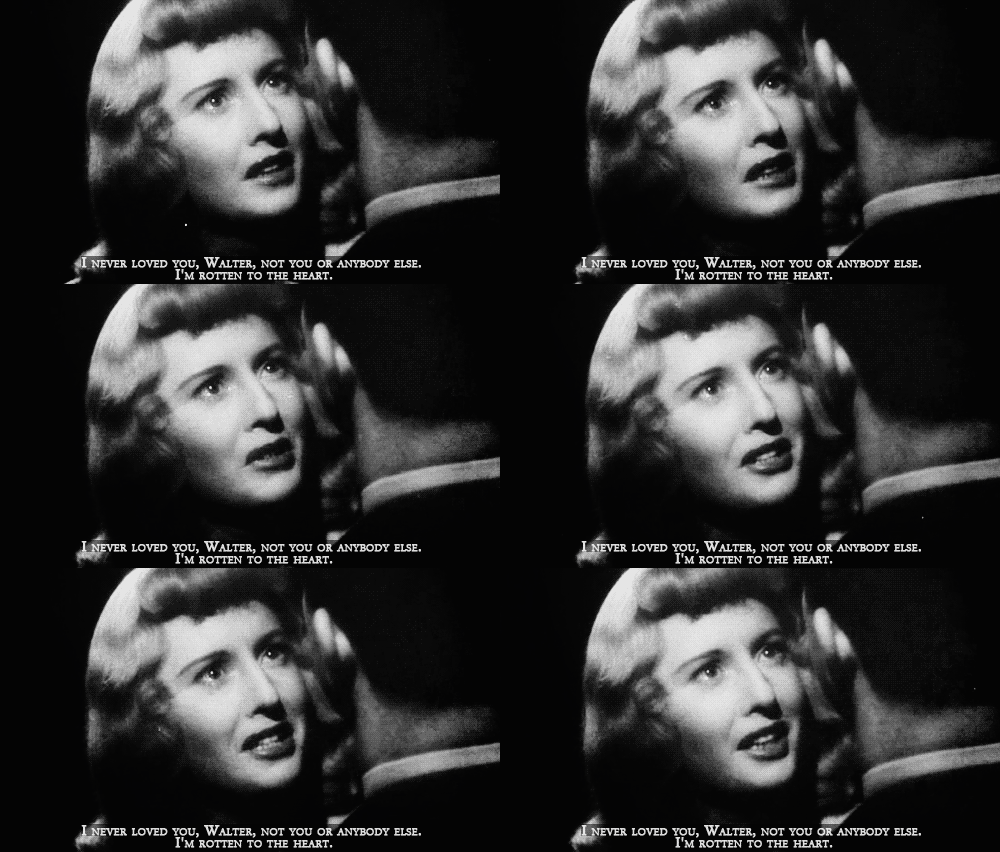
 Displaying this woman lead as a deceitful and seductive counterpart to a successful and simply "misguided" man could expose a public idea of how women were viewed as a whole in the 1940s. They could be thought of as the continuation of Eve, the woman who deceived her husband into eating the forbidden fruit. They could be seen as beautiful, but deadly. They could be seen as insecure and needy, while bold and ill-natured. Men were rotten, perhaps women were seen as "a little more rotten" as perceived by the oh-so-misguided Mr. Neff. Truth be told, it was Neff's lust for money and this woman that led to his helping her, but hey, who can say no to a person wearing a pretty anklet? Right?….
PHYLLIS
We're both rotten.
NEFF
Only you're a little more rotten.
Phyllis Dietrichson stands looking down. She is in her early thirties. She holds a large bath-towel around her very appetizing torso, down to about two inches above her knees. She wears no stockings, no nothing. On her feet a pair of high-heeled bedroom slippers with pom-poms. On her left ankle a gold anklet.
Already, in this narration from Walter Neff, Barbara Stanwyck's character is portrayed as a seductive, alluring woman. She is the wife of one Mr. Neff's clients, but that does not stop her from flirting with him basically the instant he walks in the door. She is a troubled, shifty woman that wants her husband dead, and is unhappy with his daughter too. She manipulates Fred MacMurray's character by throwing her womanly charm at him any chance she could. She also pulls on his heart strings when she says, "Walter, I don't want to kill him. I never did. Not even when he gets drunk and slaps my face."
She is not a likable character, in that she makes the viewers feel uneasy by her wild nature and devious behavior. She is seen as immoral with her lust for murder, and also a little crazy with that insane look in her eye. She is always shot at an angle from the side, rarely head on, giving the illusion of watching from the outside, never really understanding her motive or true self. The only times she is filmed head on is when she is scheming with that crazy look in her eye, or when she is trying to be seductive to Mr. Neff.

She is surrounded by a fuzzy light when she is meant to look seductive and appealing. When she is planning murder or revealing a dark and wicked side of her, the lighting is either dark or dim, displaying her secretive persona.
Displaying this woman lead as a deceitful and seductive counterpart to a successful and simply "misguided" man could expose a public idea of how women were viewed as a whole in the 1940s. They could be thought of as the continuation of Eve, the woman who deceived her husband into eating the forbidden fruit. They could be seen as beautiful, but deadly. They could be seen as insecure and needy, while bold and ill-natured. Men were rotten, perhaps women were seen as "a little more rotten" as perceived by the oh-so-misguided Mr. Neff. Truth be told, it was Neff's lust for money and this woman that led to his helping her, but hey, who can say no to a person wearing a pretty anklet? Right?….
Subscribe to:
Posts (Atom)